Immersive Recording · Editing · Spatial Mixing
Prague, Czech Republic · June 2026
Role
Recording Engineer · Editor · Immersive Audio Mixer
Focus
Immersive recording · Multichannel microphone techniques · Spatial imaging · Binaural delivery
Tools
Pro Tools · Multichannel Microphone Arrays · Spatial Audio Workflow

Project Overview
Selected Sessions
MUFF — Hybrid Studio and 3D Recording Experiment
This session was a comparative recording experiment with the band MUFF, whose music incorporates strong experimental elements. A conventional multitrack studio setup and a dedicated 3D microphone array captured the same live performance simultaneously. The traditional system provided directness, instrumental separation, and detailed control, while the spatial array captured the room’s width, depth, height, and natural ambience. The final mix combined both systems to preserve clarity and focus while creating a more dimensional and immersive sense of space.
My Role
Microphone setup · Pro Tools operation · Session recording · Editing · Final mixing
Recording Approach
The conventional multitrack setup captured direct and individually controllable signals from each instrument, providing articulation, tonal definition, and stable frontal localization. A separate 3D microphone array recorded the same performance from horizontal, elevated, Ambisonic, and boundary perspectives. Recording both systems simultaneously made it possible to compare their spatial characteristics and later combine them within the final mix.
Mixing Challenge
The main challenge was integrating the precision of the conventional multitrack recording with the broader and more diffuse spatial information captured by the 3D array. I used the direct signals as the foundation for tonal balance and localization, then introduced the spatial channels selectively to increase depth, envelopment, and vertical ambience without reducing instrumental clarity or weakening the frontal image.
Microphone Setup
Conventional Studio Setup
Keyboard — Direct input
Drums — Neumann KM 184, Sennheiser MD 441, AKG D112, Neumann TLM 103
Saxophone — Neumann TLM 103
Bass — Direct input and amplifier microphone
Guitar amplifier — Oktava ML-52-02
3D Spatial Array
Horizontal surround layer
Four-channel height layer
Dual Ambisonic capture
Boundary microphone layer
Reference microphone

MUFF performing during a simultaneous conventional multitrack and 3D spatial recording experiment.
Full Mix
Final hybrid mix combining the conventional multitrack recording with the 3D spatial array.
Listen to Full Mix ↗
Artist — MUFF
Location — Faust Studio, Prague
Date — June 24, 2026
Haskontrabass Oktet — Immersive Church Recording
Four vocalists and four double bass players recorded with a layered multichannel microphone system at Husova Church in Prague.
Haskontrabass Oktet was recorded at Husova Church in collaboration with eight Prague-based artists: four vocalists and four double bass players. The session explored how a layered multichannel microphone system could capture the ensemble’s low-frequency weight, vocal detail, physical arrangement, and the expansive reverberation of the church. The recording combined a main spatial array, elevated and surround perspectives, individual spot microphones, Ambisonic capture, and boundary microphones to preserve both musical clarity and a convincing sense of the performance space.
My Role
Microphone setup · Session recording · Editing · Mixing
Recording Approach
The ensemble was recorded with multiple complementary microphone layers. Three Sennheiser MKH 800 TWIN microphones formed a six-channel main array, capturing separate front- and rear-facing capsule signals for flexible spatial shaping in post-production. Four additional Sennheiser MKH 800 microphones captured height and surround perspectives, while MKH 8050, Ambisonic, boundary, and spot microphones provided additional room and source definition.
Recording Challenge
The primary challenge was maintaining clarity and stable localization within the church’s long reverberation. Four double basses generated substantial low-frequency energy, while the vocal ensemble required enough presence to remain intelligible without sounding disconnected from the room. The spot microphones were used as support rather than as the dominant image, while the main and spatial arrays preserved the scale, depth, and natural decay of the venue.
Main & Spatial Array
Main horizontal array — Three Sennheiser MKH 800 TWIN microphones, six-channel output
Four-channel height and surround layer — Sennheiser MKH 800
Additional surround layer — Sennheiser MKH 8050
Ambisonic capture — Sennheiser AMBEO
Boundary layer — Sennheiser MKH 8040 and DPA 4011
Additional room microphone — Josephson C617
Spot Microphones
Vocal spots 1–4 — Schoeps CM6, figure-eight
Double bass spots 1–4 — DPA 4011
Four vocalists positioned left to right
Four double bass players positioned left to right
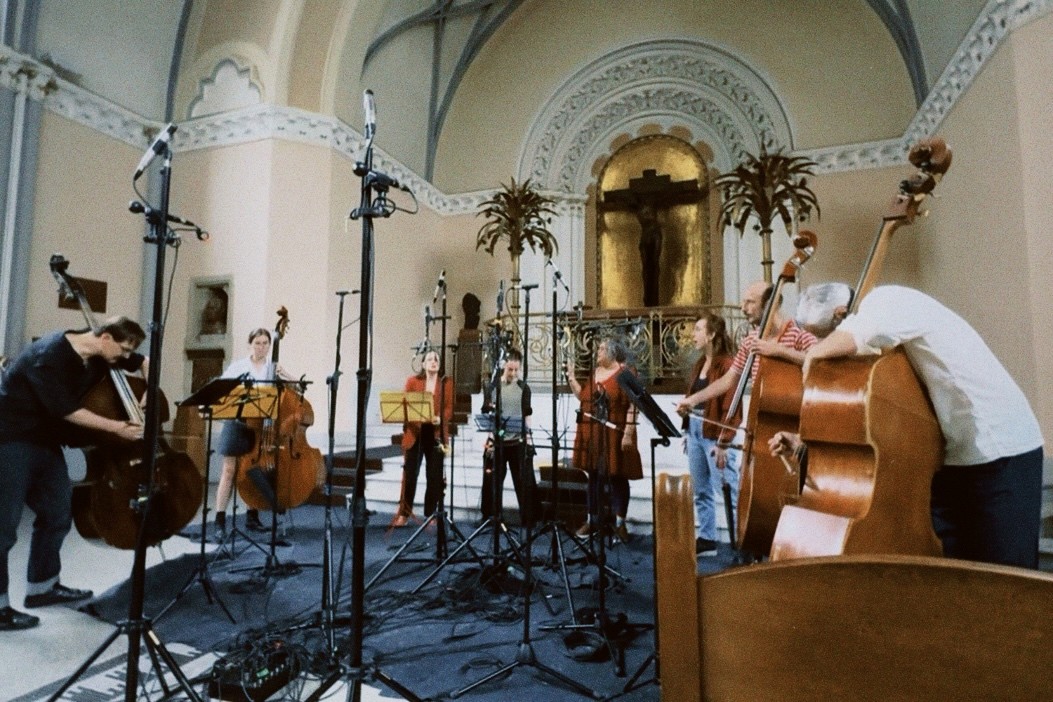
Haskontrabass Oktet performing at Husova Church in collaboration with eight Prague-based artists, recorded through a layered multichannel microphone setup.
Artists — Haskontrabass Oktet
Ensemble — Four vocalists and four double bass players
Location — Husova Church, Prague
Date — June 10, 2026
Aura Quintet — Immersive Wind Quintet Recording
A five-piece wind ensemble recorded at CNSO Studio using layered main, height, spot, Ambisonic, and boundary microphone systems.
Aura Quintet was recorded at CNSO Studio in Prague, featuring flute, oboe, clarinet, bassoon, and French horn. The session combined a multichannel main array with height, surround, individual spot, Ambisonic, and boundary microphone layers. The recording approach was designed to preserve the natural balance and interaction of the ensemble while providing sufficient definition, localization, and spatial flexibility for immersive post-production.
My Role
Microphone setup · Session recording · Editing · Mixing
Recording Approach
The main array established the ensemble’s frontal width, center image, and overall room perspective. Height and surround microphones captured additional vertical and lateral ambience, while dedicated spot microphones supported the individual tone and localization of each instrument. Additional Ambisonic and boundary layers provided alternative spatial perspectives that could be evaluated and blended during post-production without replacing the natural ensemble image.
Recording Challenge
The primary challenge was maintaining a cohesive chamber-music balance while preserving the distinct timbre and position of five instruments with very different projection characteristics. The spot microphones therefore served as subtle reinforcement, while the main and spatial arrays remained responsible for the overall scale, depth, and acoustic continuity of the recording.
Microphone Setup
Main & Spatial Array
Main left/right array — Josephson C617
Lateral surround layer — AKG C414 and Josephson C617
Height and surround-height layer — Sennheiser MKH 800
Center capture — Sennheiser MKH 800 TWIN
Sound-field capture — DPA 4011
Boundary layer — Neumann KM 184
Spot Microphones
Flute — DPA 4011
Flute height — Schoeps CMC 6, figure-eight
Oboe — Sennheiser MKH 8050
Oboe height — Sennheiser MKH 8040, cardioid
French horn — DPA 4011
French horn height — Schoeps CMC 6, figure-eight
Bassoon — Sennheiser MKH 8050
Bassoon height — Sennheiser MKH 8040, cardioid
Clarinet — DPA 4011
Clarinet height — Schoeps CMC 6

Aura Quintet performing at CNSO Studio, recorded with layered main, height, spot, Ambisonic, and boundary microphone systems.
Artist — Aura Quintet
Ensemble — Flute, oboe, clarinet, bassoon, and French horn
Location — CNSO Studio, Prague
Date — June 9, 2026
Reflection
Martain Ma
© 2026